Choosing an Acoustic Guitar manufacturer in China involves more than comparing catalog prices. Buyers must assess tone consistency, construction, production capacity, and communication before placing an order. Grand View Research estimated the global guitar market at USD 10.3 billion in 2023 and projected a 7.2% compound annual growth rate through 2030. Its market analysis covers guitars broadly, so it should not be mistaken for a China-specific acoustic guitar export forecast. Still, it signals a competitive market where dependable sourcing matters.
This guide introduces ten Chinese manufacturers for buyers to investigate. It focuses on practical checks: solid-top or laminate specifications, bracing and neck construction, finish quality, factory customization, minimum order quantities, and sample lead times. Ask for clear model specifications and inspect a physical sample when possible. A glossy product photo cannot reveal fret buzz, uneven binding, or how a guitar responds under the fingers. Small details count.
Supplier claims also deserve careful review. Request current certifications, production references, and written quality-control procedures, then confirm that documents match the factory and product offered. Rankings alone cannot establish fit. A factory suited to a large private-label order may not serve a small boutique brand well. And specifications do not tell the whole story; playability can vary between instruments. Use this shortlist as a starting point, not a substitute for due diligence.
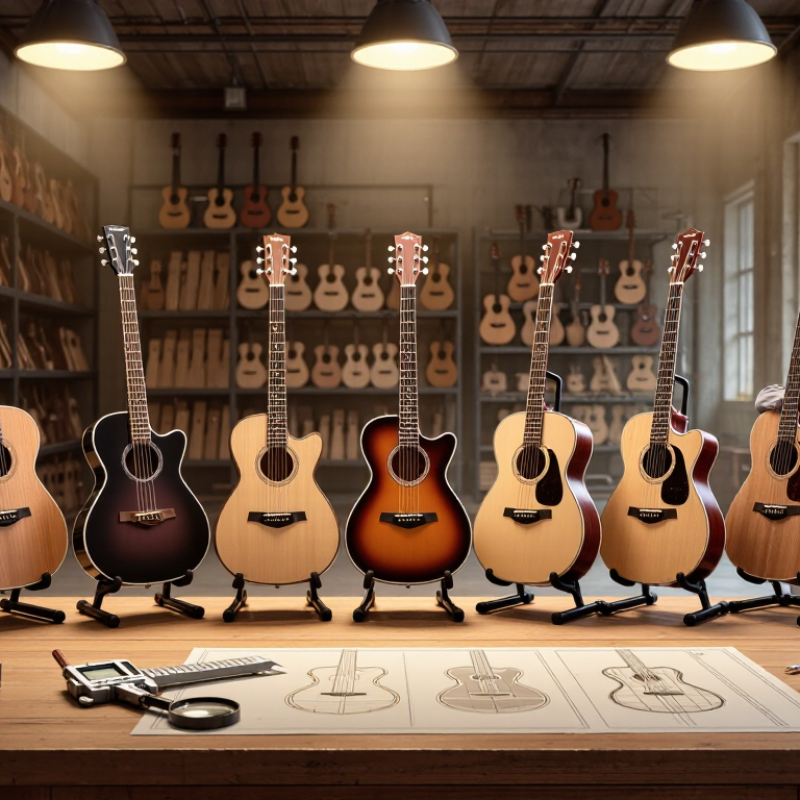
China’s acoustic-guitar manufacturing industry combines woodworking, component sourcing, assembly, and export production. Factories may handle everything from bracing and body sanding to fret installation and final setup. Small differences matter: uneven humidity can affect neck relief, while inconsistent fretwork can make a guitar uncomfortable to play. Production capacity is substantial, but factory capability varies; buyers should assess each supplier rather than assume uniform quality.
Fortune Business Insights estimated the global guitar market at USD 10.3 billion in 2023 and forecast a 7% compound annual growth rate through 2032. This figure covers guitars broadly, not China’s acoustic-guitar output specifically. UN Comtrade records many non-electric string instruments under HS 920290, so customs totals do not cleanly isolate acoustic guitars. That distinction matters. The sector’s scale is easier to see than its precise acoustic-guitar output, and this remains a data gap worth acknowledging.
Tips: Request a recent production sample, a written inspection checklist, and details on wood moisture control. Ask how the factory checks neck alignment and fret height. A polished sample is useful, but repeat-order consistency matters more.
For buyers comparing China-based acoustic guitar manufacturers, evaluate repeatability, not just a polished sample. Request inspection records from multiple production stages, including neck relief, fret height, bridge alignment, and finish thickness. Ask how often staff measure these points and what happens when a batch fails. Samples can mislead. A strong approval process should include instruments selected from regular production, not only hand-prepared units.
The ISO Survey 2022 recorded more than 1.2 million ISO 9001 certificates worldwide. Certification can indicate documented quality processes, but it does not prove guitar-specific workmanship. Ask for recent corrective-action records and a clear explanation of how defects are tracked. The World Bank’s 2023 Logistics Performance Index assessed 139 economies across six areas, including customs, infrastructure, and timeliness. Use those dimensions to discuss export planning, then request the manufacturer’s own shipment history and lead-time variation. One imperfect detail matters: a factory may document every step yet still overlook sharp fret ends on a small batch. Arrange a pre-shipment inspection, and confirm packaging protects the guitar’s neck and finish during transit.
China’s acoustic-guitar sector includes large export factories and smaller specialist workshops. These ten profiles highlight capabilities buyers can verify, rather than treating size as proof of quality.
One manufacturer may focus on entry-level dreadnoughts, using laminated backs and sides for consistent output. Another offers solid-top models and documents wood grading and humidity control. A third builds compact travel guitars, where neck stability matters. A fourth makes auditorium shapes with cutaways and onboard electronics. Ask for close-up fret and bridge photos. Details matter.
A fifth supplier may support custom finishes but require larger orders. A sixth emphasizes hand setup, including nut-slot depth and saddle height. A seventh offers varied scale lengths, useful for different players. An eighth specializes in left-handed instruments, though availability may fluctuate. A ninth produces classical-style guitars alongside steel-string models. A tenth may provide flexible OEM options, but its sample should match the production specification. Small inconsistencies happen. Check them.
For each factory, request a current specification sheet, sample lead time, and clear details on materials and inspection steps. Compare the same model features across quotations. A polished sample is helpful, but it cannot reveal every production variation. Ask how the supplier handles defects and reorders before committing.
A reference chart of the six open strings in standard tuning, from low E to high E.
Frequencies are approximate equal-tempered values based on A4 = 440 Hz. Actual pitch may vary with tuning and instrument setup.
For buyers comparing China’s top acoustic guitar manufacturers, product range should mean more than a long catalogue. Check whether a factory builds steel-string and nylon-string models, different body shapes, and custom specifications. Ask for a model matrix showing tonewood options, neck dimensions, finish types, and available hardware. Details matter. A factory’s sample room may look impressive, but repeat orders reveal whether specifications stay consistent.
Quality needs measurable checks. Request written inspection criteria for fret ends, action, tuning stability, finish defects, and packaging. Ask how wood is dried and stored, then compare production samples with approved reference instruments. UNIDO’s International Yearbook of Industrial Statistics 2024 identifies China as the world’s largest manufacturing economy by value added. That scale is relevant, but it does not guarantee guitar-making consistency. Buyers should verify a supplier’s actual acoustic-guitar experience, not infer it from general manufacturing capacity.
Production capability includes monthly output, lead times, order flexibility, and defect handling. Ask for recent capacity figures and clarify whether finishing or assembly is outsourced. The World Bank’s 2023 Logistics Performance Index ranks China 19th overall, offering useful context for export logistics, not a guarantee of delivery on schedule. A factory may quote a fast turnaround; request a sample timeline and a written plan for delays. I would still treat polished factory claims cautiously. The uncomfortable part is that a low unit price can hide costly variation.
Choosing from China’s leading acoustic guitar manufacturers starts with your order requirements, not a factory’s sales pitch. Define the body shape, tonewood grade, finish, hardware, packaging, and target price in a written brief. Be specific. Details such as fret-edge smoothness and action height can affect player feedback. Ask whether the quoted price includes setup, inspection, and export packaging.
Request a sample made to the proposed production specification. Check tuning stability, neck relief, intonation, and finish under consistent conditions. Photograph defects and agree on measurable acceptance limits before paying a deposit. Ask about production capacity, material sourcing, lead times, and how specification changes are approved. Factory visits or independent inspections can help, but neither replaces clear records.
Compare at least three written quotations, including tooling, sample fees, minimum order quantities, payment milestones, and revision costs. Do not choose on unit price alone. A low quote may omit setup work or use components that differ from the sample. That difference is easy to miss. Keep communication in one approved specification sheet; otherwise, a small change can become an expensive misunderstanding.
Request inspection records for neck relief, fret height, bridge alignment, and finish thickness. Ask how often staff check them. Samples can mislead.
Certification may show documented processes, but it does not prove guitar-specific workmanship. Ask for recent defect records and corrective actions.
Request samples drawn from regular production. Compare them with the approved instrument for action, tuning stability, finish, and fret edges. Small differences matter.
Ask about monthly capacity, lead times, order flexibility, and outsourced work. Get a written plan for delays. Fast promises are not guarantees.
List body shape, tonewood grade, neck dimensions, finish, hardware, setup, and packaging. Include measurable limits for action and fret-edge smoothness.
Request shipment history, typical lead times, and information about packaging. Confirm the case or carton protects the neck and finish. Transit damage is easy to overlook.
Compare at least three written quotations. Check tooling, sample fees, minimum order quantities, payment milestones, and revision costs, not only unit price.
Keep approved specifications in one shared document. Record every change and get written approval. A tiny adjustment can become expensive. I would still double-check.
China’s acoustic guitar manufacturing industry offers buyers a broad mix of production capabilities, product options, and service models. This overview explains how to assess potential manufacturers by considering factors such as craftsmanship, material selection, quality control, customization, production capacity, communication, and delivery expectations. It also introduces ten leading manufacturers in general terms, helping readers understand the range of suppliers available without focusing on any single brand.
A practical comparison of product range, quality standards, and manufacturing capacity can help buyers narrow their options. The article also outlines a clear sourcing process: define product requirements, request and evaluate samples, confirm specifications and quality procedures, and discuss production schedules and support before placing an order. With careful research and direct communication, buyers can identify a suitable manufacturing partner for their Acoustic Guitar needs.