 English
 Español
 Deutsch
 Français
 Português
 Italiano
 Русский
 日本語
 한국어
 العربية English Español Deutsch Français Português Italiano Русский 日本語 한국어 العربية
Standard-setting acoustic models and precision manufacturing capabilities available for private label procurement.
An authoritative analysis of tonewood seasoning, luthier engineering, automated production lines, and supply chain dynamics for B2B musical instrument buyers.
The global acoustic and folk guitar market has undergone a fundamental structural shift over the past decade. China has transformed from a low-cost, high-volume assembly hub into the world’s most technologically advanced manufacturing center for steel-string acoustic and folk guitars. For international musical instrument brands, regional distributors, and e-commerce chain store operators, navigating this mature manufacturing landscape requires a deep understanding of acoustic engineering standards, climate-controlled wood seasoning protocols, and automated manufacturing precision.
Acoustic guitar manufacturing is intrinsically more complex than electric guitar production due to the structural reliance on wood resonance, plate tension balance, and internal bracing architecture. A folk guitar must withstand up to 160 pounds (73 kg) of total string tension while remaining ultra-responsive to delicate tactile input. Leading Chinese OEM/ODM factories—such as Changsha YBUL Instrument Co., Ltd.—have integrated advanced aerospace-grade CNC routing, automated high-frequency vacuum wood drying, and computerized laser fret-slotting with traditional hand-lutherie craftsmanship to deliver unparalleled batch consistency.
Understanding how wood density, bracing geometry, and moisture equilibrium directly dictate acoustic tone, projection, and long-term instrument stability.
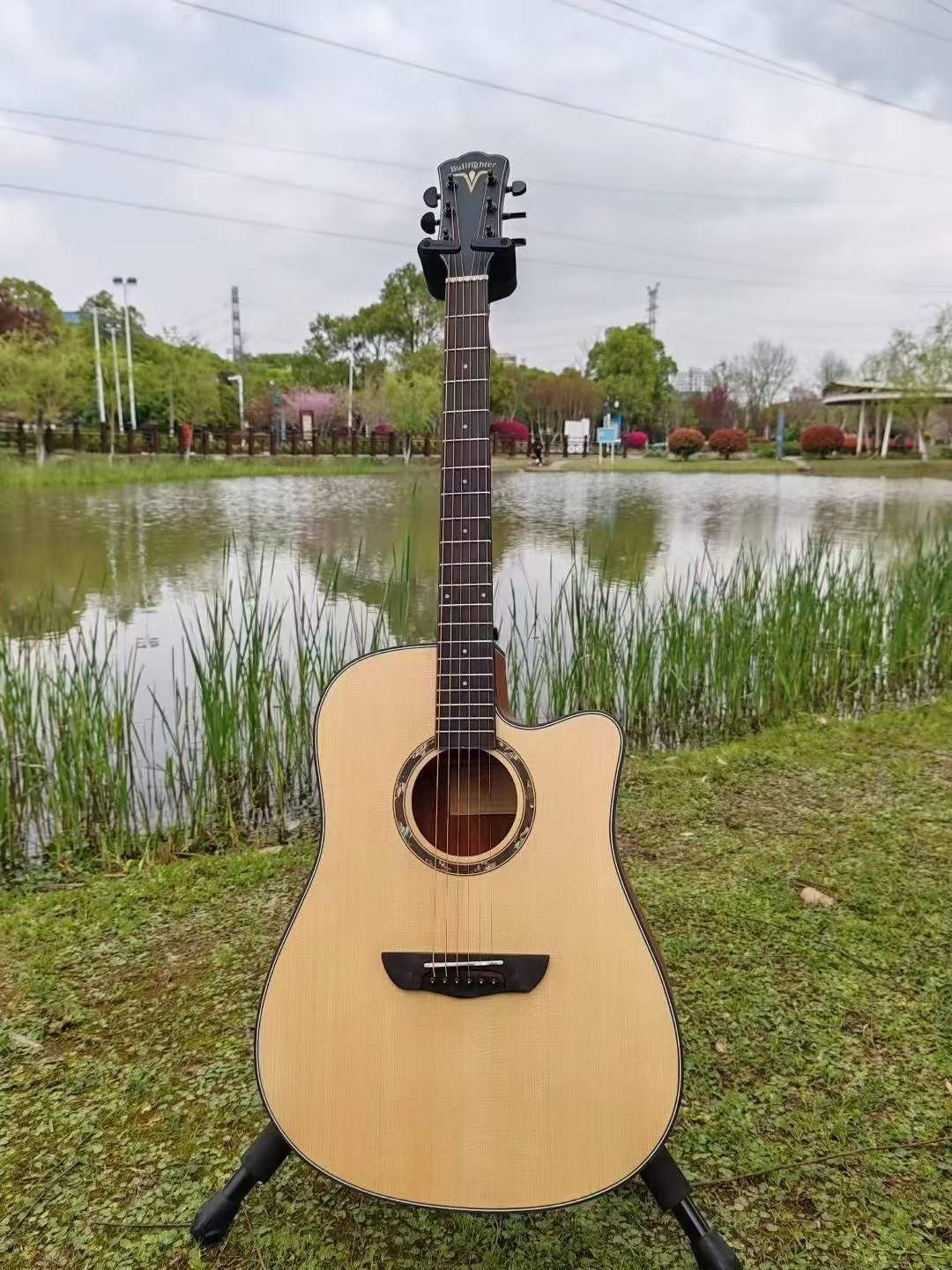
The acoustic heart of any folk guitar resides in its top soundboard. In high-tier OEM manufacturing, the choice of soundboard wood, coupled with precise plate-tuning, determines a brand’s sonic identity. High-grade folk guitars manufactured in China predominantly utilize AA/AAA Engelmann Spruce, Sitka Spruce, or Solid Red Cedar for soundboards, paired with Sapele, Mahogany, or Rosewood for back and side laminates or solid bodies.
The primary point of failure in global guitar distribution is environmental cracking, neck bowing, and bridge lifting caused by improper timber seasoning. Modern tier-1 factories implement a rigorous two-stage timber conditioning process:
Folk guitars rely heavily on traditional or modified Scalloped X-Bracing systems. By precision-milling brace profiles using multi-axis CNC machines, Chinese factories achieve uniform stiffness-to-weight ratios across soundboards. Scalloping the X-braces near the lower bout frees the perimeter of the top, enhancing bass response and projection, while maintaining structural rigidity directly beneath the bridge plate.
| Wood Species / Component | Acoustic Character & Density | Structural Role | Target B2B Product Tier |
|---|---|---|---|
| Solid Engelmann Spruce | Low density, high stiffness; dynamic, overtone-rich clarity. | Soundboard (Top Plate) | Mid-to-High Tier Folk Guitars |
| Solid Sitka Spruce | High fundamental velocity, punchy projection, strong headroom. | Soundboard (Dreadnought / Grand Auditorium) | Professional Stage & Studio Folk Lines |
| Sapele / Mahogany | Warm midrange focus, tight low-end decay, high structural stability. | Back & Sides / Neck Core | High-Volume Wholesale & OEM Lines |
| Rosewood (Dalbergia) | Deep, scoop-mid voice with sparkling highs and rich bass resonance. | Fingerboard, Bridge & Premium Sides | Flagship Private-Label Models |
| Roasted / Torrefied Maple | Thermal crystallization removes volatiles; immune to humidity shifts. | Neck Profile & Electric/Hybrid Necks | Export-Grade All-Weather Guitars |
Key macroeconomic shifts, environmental compliance regulations, and product innovations shaping the future of folk guitar supply chains.
Global regulatory bodies require total transparency in timber sourcing. The industry is rapidly shifting toward CITES-compliant alternatives, including high-density Technical Wood (Ebonized Poplar), FSC-certified plantation Sapele, and eco-friendly bamboo composites that offer legal compliance and timber consistency.
Modern consumers demand onboard digital sound processing (DSP) without external amplifiers. Future-proof procurement orders increasingly specify built-in actuators, Bluetooth connectivity, reverb/delay effects directly within the acoustic cavity, and rechargeable lithium-ion preamps.
High-volume minimum order quantities (MOQs) are giving way to agile, micro-batch private label programs. Importers require factory partners capable of offering 100-to-300 unit custom production runs with laser-etched headstock logos, custom body colors, and specialized neck profiles.
Fretwork determines playable action and prevents fret buzz. Leading factories are incorporating automated CNC fret dressing, high-precision laser slotting, and climate-controlled assembly rooms to ensure out-of-the-box playability for global retail distribution.
With direct-to-consumer e-commerce dominating retail growth, guitars must be packaged to withstand international parcel shipping. Suppliers must provide ISTA-tested, 5-ply double-wall cartons, custom-molded EPS foam inserts, and moisture-absorbing silica packs.
Torrefaction bakes soundboard timber in an oxygen-depleted kiln, artificially aging the wood fibers by decades. This process yields vintage acoustic resonance, structural stability, and a rich golden-amber aesthetic highly coveted by modern folk guitar players.
Combining dual-factory industrial scale with rigorous third-party assessment to power international instrument brands.
When selecting a Chinese folk guitar factory, foreign buyers must distinguish between small assembly workshops and verified industrial manufacturers. Changsha YBUL Instrument Co., Ltd. (operating brand Bullfighter) represents the modern standard of Chinese musical instrument manufacturing.
Headquartered in Changsha, Hunan, with a 2,500㎡ R&D and office center plus two heavy-duty manufacturing facilities covering a total of 16,483 square meters, YBUL combines complete vertical integration with international trade expertise. The enterprise has been verified onsite by the world-leading inspection group SGS Group, giving international buyers verified peace of mind regarding facility size, employee headcount, machine inventory, and manufacturing capacity.
To guarantee zero-defect shipments, every folk guitar produced in our factory must clear nine strict inspection checkpoints:
Digital moisture meters verify wood core dampness stays strictly within the 6–8% safety window prior to cutting.
High-pressure hydraulic clamping ensures seam joints on acoustic tops and backs never split under climate stress.
Precision computer routing creates exact neck pockets, bridge locations, and internal bracing rebates.
Multiple sanding passes up to 800-grit prepare raw wood for ultra-thin polyurethane or nitrocellulose lacquering.
Dust-free spray booths apply thin, acoustically resonant finishes that protect the wood without deadening tone.
Painted bodies cure in humidity-regulated drying rooms to prevent finish sinking, blushing, or clouding.
Technicians hand-crown fret ends and level fretboards under simulated string tension for flawless action.
Piezo preamps, output jacks, nut slots, intonation, and relief are verified using electronic beat calibrators.
Instruments are double-boxed, sealed with moisture barrier bags, and prepared for ocean or air freight.
Direct, transparent answers regarding production capacities, custom branding, logistics, and quality assurance.
Partner with an SGS-assessed Chinese manufacturer. Receive engineered product specifications, factory-direct pricing catalogs, and OEM sample production timelines within 24 hours.