English
 Español
 Deutsch
 Français
 Português
 Italiano
 Русский
 日本語
 한국어
 العربية English Español Deutsch Français Português Italiano Русский 日本語 한국어 العربية
Precision-engineered acoustic instruments, solid-body electrics, and tour-grade gig bags manufactured under certified ISO-aligned production protocols.

Understanding velocity of sound, resonant cavity mechanics, and structural load distribution in commercial guitar manufacturing.
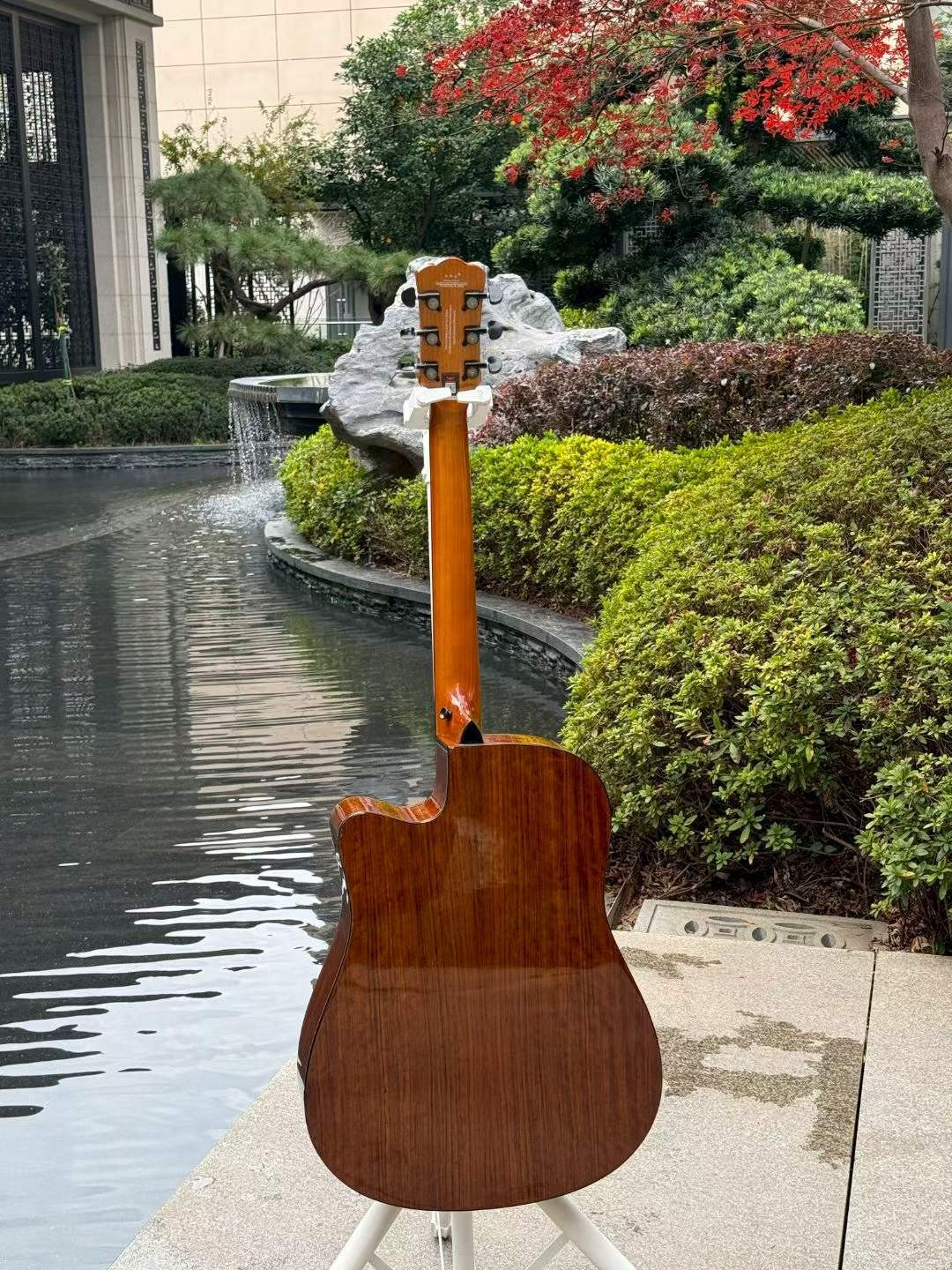
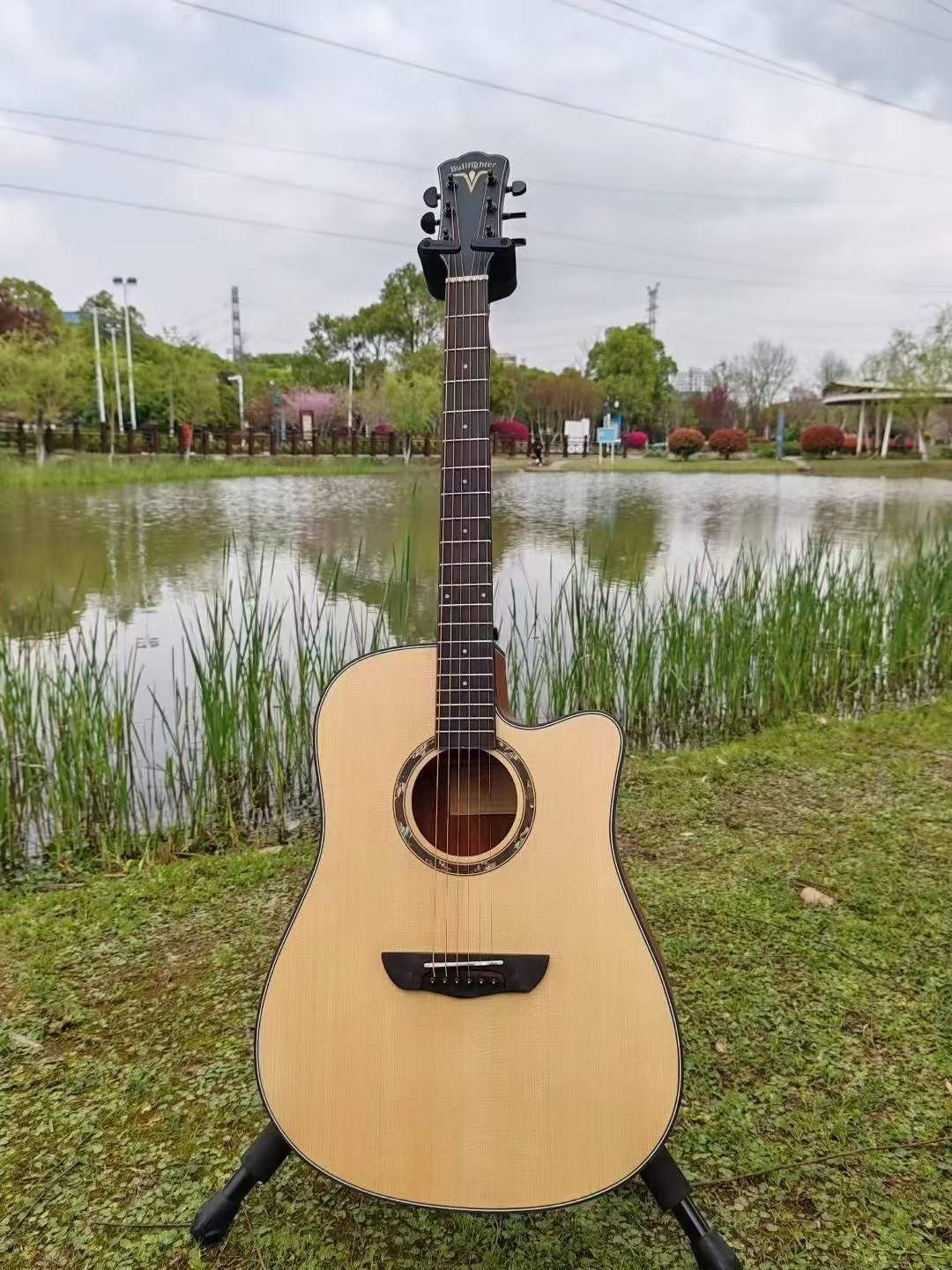
In the global stringed instrument trade, the 41-inch Dreadnought acoustic guitar remains the absolute benchmark for acoustic projection, low-end resonant response, and overall dynamic headroom. Originally developed to overcome the projection limits of small-bodied parlor guitars in ensemble settings, the Dreadnought geometry demands exact acoustic coupling between the soundboard, side ribs, and backplate. For global guitar brands, OEM importers, and wholesale music distributors, sourcing from a competent custom OEM Dreadnought guitar manufacturer requires a deep understanding of timber mechanics, bracing architecture, and structural load management.
At Changsha YBUL Instrument Co., Ltd., our acoustic engineering protocols analyze every batch of tonewood through ultrasonic velocity testing and grain density profiling. The top soundboard acts as an acoustic diaphragm; when driven by string tension—typically exerting 160 to 180 lbs of constant pull under standard E tuning—the internal bracing system must balance physical structural integrity against free acoustic resonance.
Our CNC-milled quarter-sawn spruce bracing utilizes forward-shifted X-patterns with hand-carved scalloped ends. This reduces soundboard peripheral mass while maintaining central bridge stability, expanding lower-mid resonance by up to 3.5 dB.
Mechanical energy transfer from neck to body relies on a zero-gap compound dovetail neck joint. CNC router routing maintains tolerances within ±0.03mm, eliminating energy-dissipating glue gaps common in low-tier bolt-on designs.
The 41-inch Dreadnought body cavity volume is tuned precisely to ~28.5 liters. Combined with a 100mm soundhole diameter, the Helmholtz resonance peak aligns perfectly with the A2 to B2 fundamental frequency band.
Sourcing acoustic and electric instruments from China requires a verified manufacturing partner capable of delivering consistent fretwork, structural stability, and pristine finishes across thousands of units. Changsha YBUL Instrument Co., Ltd. stands as an industry-leading OEM/ODM manufacturer headquartered in Changsha, Hunan, with a total operational footprint of 16,483 square meters spread across two modern production facilities and a 2,500㎡ R&D center.
Our enterprise operations have been independently audited and assessed onsite by SGS Group, confirming our status as a authentic custom manufacturer rather than a standard intermediary trading firm. Operating with 101–200 skilled craftsmen, dedicated wood-drying technicians, and international sales specialists, YBUL maintains a monthly production capacity exceeding 15,000 acoustic and electric guitars and 1,000 amplifier and electronic drum units.
| Tonewood Species | Grain Density (kg/m³) | Sonic Velocity (m/s) | Acoustic Role | Tonal Spectrum & OEM Target Market |
|---|---|---|---|---|
| Sitka Spruce (Solid/Top) | 430 - 480 | 5,500 | Soundboard / Top | High velocity of sound, crisp articulation, wide dynamic range. Standard for mid-to-high tier OEM dreadnoughts. |
| Engelmann Spruce | 400 - 430 | 5,200 | Soundboard / Top | Slightly softer than Sitka, richer overtones, ideal for fingerstyle acoustic lines and studio-grade cutaway models. |
| Sapele / Mahogany | 560 - 650 | 4,600 | Back & Sides / Neck | Warm fundamental punch, strong midrange focus, excellent structural elasticity for stable neck construction. |
| Indian Rosewood | 750 - 850 | 4,300 | Fretboard & Bridge | High density, oily pore structure, smooth tactile feel, exceptional decay time and high-frequency sparkle. |
| Roasted Maple | 610 - 680 | 4,800 | Neck / Fretboard | Thermal vacuum cured; moisture content under 3%. Complete immunity to environmental humidity warping. |
Key industry shifts reshaping supply chain management, compliance, and material selection for international guitar brands.
As strict CITES regulations govern endangered Rosewood (Dalbergia) species, major global importers are pivoting toward high-tech sustainable alternatives. Tech-wood, baked Okoume, engineered Rosewood, and certified Walnut offer identical structural density and resonance without international customs import clearance friction or environmental penalties.
Torrefaction (thermal roasting in oxygen-free kilns at 180°C–220°C) crystallizes natural wood resins, aging the acoustic top by decades in hours. Roasted Spruce tops and Roasted Maple necks are moving from boutiqu-only custom shops to high-volume OEM lines, offering enhanced resonance and dark, vintage aesthetics.
Legacy heavy polyester finishes dampen soundboard vibrations. Modern OEM buyers require automated UV-curing spray lines that apply durable finish coatings under 0.12mm in thickness. This provides extreme scratch resistance while allowing soundboards to flex freely for maximized voice projection.
The boundary between acoustic and electronic instruments continues to blur. Modern procurement demands onboard piezo pickup systems with internal body-actuator resonance (reverb and chorus effects routed internally through the soundhole without an external amplifier), boosting retail unit margins significantly.
Traditional 1,000-unit minimum orders per SKU are giving way to multi-model container batching. Distributors now demand hybrid container loads combining acoustic dreadnoughts, cutaways, electric solid-bodies, and gig bags under unified brand styling to reduce inventory holding costs.
Global brands are phasing out unverified trading houses in favor of direct-factory partnerships with verified SGS, ISO, or BSCI audit credentials. Transparent supply chains protect importers against sudden quality drops and delivery schedule breaches.
In high-volume guitar production, micro-variations in timber grain or fret installation create massive aftermarket warranty risks. To guarantee that every guitar arriving in your overseas warehouse is immediately retail-ready, YBUL enforces a rigorous 9-stage quality control protocol backed by precision industrial instrumentation.
| Inspection Stage | Testing Parameter & Tooling Used | Tolerance Standard | Risk Prevented |
|---|---|---|---|
| 1. Raw Timber Drying | Pinless Electromagnetic Moisture Meters | 8% – 10% Moisture Content | Wood swelling, side seam splitting, top sinkage. |
| 2. CNC Routing & Cavity Milling | Multi-Axis Industrial CNC Routers | ±0.03 mm Pocket Dimension | Loose neck joint, neck angle misalignment. |
| 3. Fretwire Installation | Pneumatic Fret Press & Precision Beveling | Zero fret end overhang / high frets | Fret buzz, sharp fret edges ("fret sprout"). |
| 4. Finish Application & Buffing | Automated Reciprocating Spray Booth | 0.10 mm – 0.14 mm Film Thickness | Finish orange peel, finish sinking, acoustic dampening. |
| 5. Acoustic & Electronic Setup | Strobe Tuners & Digital Calipers | 12th Fret Action: 2.0mm (Treble) / 2.5mm (Bass) | Uncomfortable playability, poor intonation across neck scale. |
| 6. Export Drop & Humidity Test | Environmental Climatic Chamber & Drop Tester | ISTA 1A Transit Standard Pass | In-transit carton crushing, bridge detachment under humidity spike. |
Essential answers regarding factory credentials, OEM customization options, minimum order quantities, and international trade terms.