Acoustic
 English
 Español
 Deutsch
 Français
 Português
 Italiano
 Русский
 日本語
 한국어
 العربية
Optimized for South Korean studio session dynamics, prog-metal demands, and boutique acoustic distribution



The contemporary music landscape across the Seoul Metropolitan Area—spanning the live indie sanctuaries of Hongdae (Mapo-gu), the technical live session clusters in Gangnam, and commercial wholesale distribution hubs like the iconic Nagwon Arcade (Jongno-gu)—has developed an intense structural demand for premium extended-range instruments. As modern heavy progressive rock, metalcore, and K-Pop crossover arrangements increasingly require lower fundamental frequencies (ranging from drop-A down to standard low B at 30.87 Hz), the traditional six-string platform often fails to deliver the string tension, harmonic clarity, and scale-length stability demanded by professional Korean sound engineers.
For music distributors, boutique retail chains, and original instrument brands operating in South Korea, sourcing seven-string guitars presents unique physical and mechanical challenges. The added tension of a seventh string (typically .056 to .064 gauge in standard tuning, or upwards of .070 for lower registers) introduces asymmetrical rotational torque across the neck profile. Without rigorous wood selection, high-frequency vacuum curing, and reinforcement rod integration, instruments imported into the Korean peninsula frequently succumb to neck twisting and fret sprout due to Seoul’s extreme seasonal climate shifts—transitioning from scorching, sub-tropical humid summers to sub-zero, bone-dry winter Siberian fronts.
Changsha YBUL Instrument Co., Ltd. (operating the Bullfighter and Minsine manufacturing lines) bridges this engineering divide. Operating two production plants spanning 16,483 square meters, staffed by 101 to 200 dedicated lutherie technicians, and verified on-site by SGS Group, our facility delivers customized seven-string solid-body and multiscale electric guitars engineered specifically for the acoustic, physical, and logistical standards of Seoul’s musical economy.
South Korea’s relative humidity (RH) profile presents one of the most volatile environments in East Asia. July and August in Seoul regularly record indoor RH values exceeding 80%, while winter heating systems across urban apartments, Hongdae rehearsal studios, and retail display racks drag humidity levels down below 20%. Under these conditions, an extended-range guitar neck—possessing a broader width across the nut (typically 48mm for seven strings compared to 42mm for six strings)—acts as a hyper-sensitive hygroscopic element.
| Component Tier | Material Engineering | Acoustic / Mechanical Implication | Seoul Localization Fit |
|---|---|---|---|
| Neck Core | Torrefied Roasted Canadian Hard Maple (3-Piece Laminated) | Moisture evacuated at 200°C; crystalized cell walls eliminate thermal expansion and warpage. | Withstands dry winter heating in Seoul apartments without back-bowing. |
| Reinforcement | Dual Dual-Action Truss Rods + Twin Carbon Fiber Spars | Neutralizes asymmetrical torsional torque created by tension differential (.010 vs .059 gauge). | Maintains surgical 1.2mm string action at the 12th fret without fret buzz. |
| Fingerboard | Quarter-Sawn Rosewood or Technical Composite Ebony | High surface hardness (Janka rating > 1200), zero pore contraction, smooth lateral glides. | Resists fret wire protruding/sprouting during abrupt seasonal climate shifts. |
| Body Substrate | Selected Lightweight Okoume / Seasoned Swamp Ash | Tight resonant acoustic punch, balanced mid-frequency boost that cuts through K-Pop brass/synth layers. | Optimal live stage weight under 3.7kg for extended Hongdae gigging sessions. |
| Fretwork | 2.7mm Extra Jumbo Stainless Steel (Hand-Dressed Hemispherical Ends) | Absolute zero wear under heavy vibrato and abrasive nickel-wound string friction. | Provides effortless speed and low maintenance for rigorous Seoul session players. |
Our manufacturing floor tackles tonewood instability prior to the initial CNC pass. Timber stock is routed through our proprietary high-frequency vacuum drying equipment, accelerating the extraction of free moisture while stabilizing chemically bound cellular water. Bodies and laminated neck blanks are held within climate-stabilized curing zones for up to 90 days before reaching our multi-axis CNC routing line. This guarantees that when a consignment of seven-string guitars departs our factory for Incheon Port, each instrument features an internal equilibrium moisture content (EMC) of 8% to 10%—the exact international standard for northern temperate deployment.
Understanding the exact application scenarios of end-users across Seoul allows commercial buyers to formulate precise OEM/ODM product briefs. Our production lines supply three primary functional sectors throughout the metropolitan region:
The concentration of underground clubs—such as Club FF, Rolling Hall, and Prism Hall—fosters an intense progressive metal, post-hardcore, and djent community. Guitarists in this sector prioritize fast neck profiles (such as an ultra-slim modern C-shape transitioning from 19mm at the 1st fret to 21mm at the 12th fret), a flat 16-inch fingerboard radius, and direct-mount high-output Alnico 5 or ceramic humbuckers. The seventh string must not turn muddy or flub out during palm-muted percussive chugs. To cater to this market, our factory incorporates custom-voiced humbuckers with asymmetrical coil windings that tighten lower midrange harmonics while preserving crisp top-end pick attack.
K-Pop music arrangements are globally recognized for dense, genre-bending production textures. Leading producers across Gangnam, Mapo, and Seongsu frequently layer extended-range heavy guitars beneath EDM synths and urban sub-bass tracks. In these professional studio setups, silent electronic shielding is mandatory. YBUL seven-string models feature full conductive graphite cavity coatings, braided silver-wire ground runs, and coil-splitting push-pull potentiometers that allow instant shifting from crushing low-end rhythm beds to chimey, glass-like single-coil cleans suitable for R&B and funk verses.
Wholesale buyers supplying brick-and-mortar dealers in Nagwon Arcade, as well as high-volume merchants driving online sales via Coupang Rocket Delivery and Naver Shopping, require out-of-the-box readiness. Return rates on extended-range instruments are notorious when intonation and action are misaligned. Every unit passing our line undergoes dual dimensional inspection via digital vernier calipers and electronic beat-frequency pitch calibration. Korean consumers are notoriously discerning regarding aesthetic imperfections; our multi-stage electrostatic painting lines and clean-room drying booths deliver mirror-like polyurethane and razor-thin satin finishes free of orange peel, sanding scratches, or lacquer build-up at the neck joint.
Over the past five years, the musical instrument retail landscape in South Korea has undergone radical transformations. Overseas procurement managers representing Seoul-based enterprises consistently report three major structural market dynamics:
Standard 25.5-inch scale lengths on seven-string guitars frequently yield inadequate tension on the low B string unless heavy gauge strings are utilized, which in turn deadens acoustic resonance. South Korean buyers are increasingly requesting fanned-fret multiscale systems (e.g., 25.5-inch on the high E transitioning to 27.0-inch on the low B) paired with roasted flame or bird's-eye maple necks. This setup ensures consistent string tension across all seven registers, allowing pristine chord voicing and lightning-fast low-register tracking without requiring unwieldy string gauges.
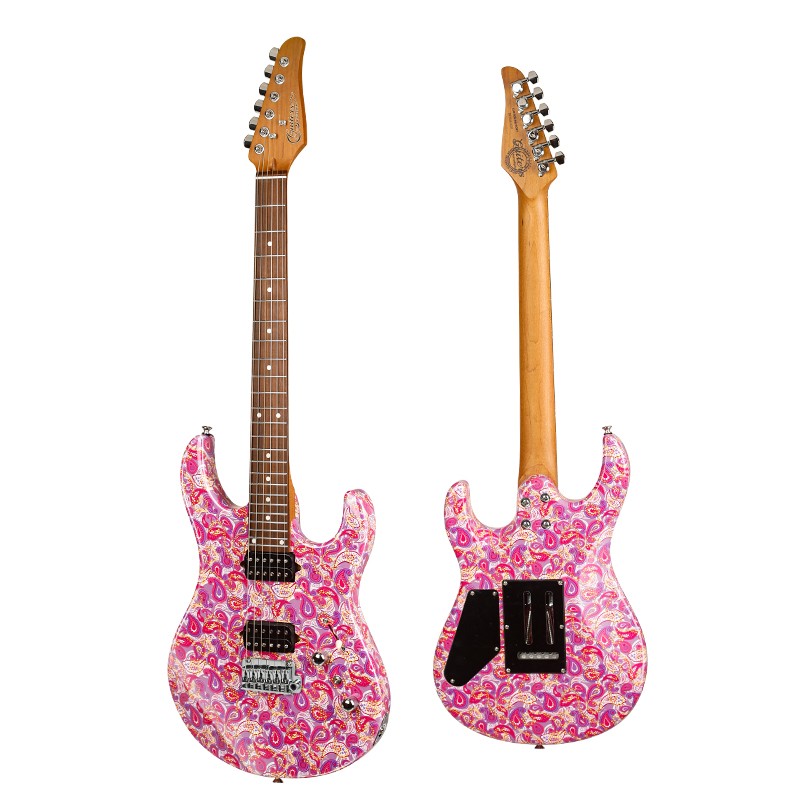
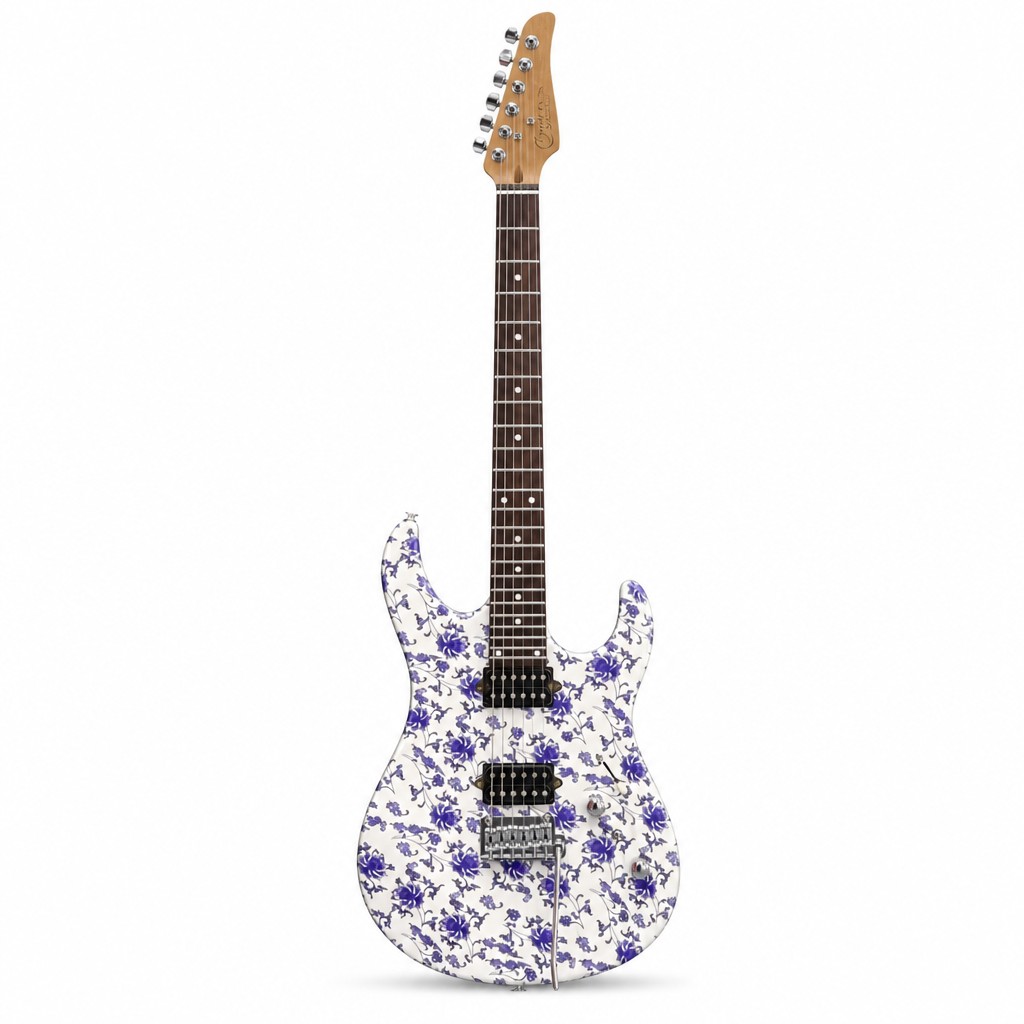
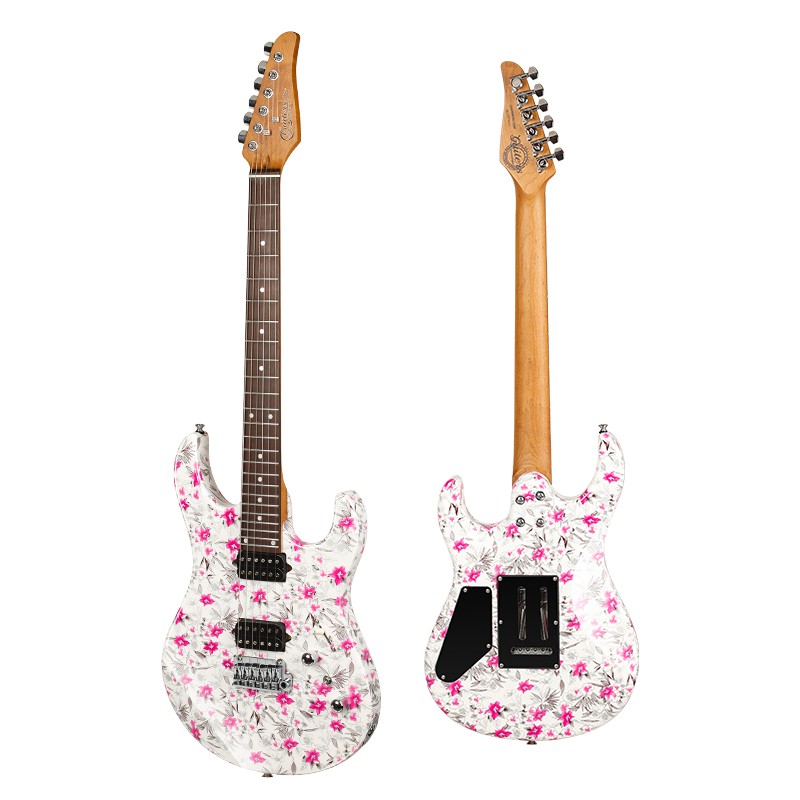
Rather than ordering 1,000 units of a single generic gloss-black shape, Seoul brands and music academies favor specialized capsule runs of 50 to 100 units per colorway. High-end finishes—such as our purple paisley finishes, white-purple floral motifs, and celestial burl veneers seen on our GT-20D series—allow boutique brands to command retail margins exceeding 45% in urban Korean retail boutiques.
Logistical geography provides China-to-Korea guitar trade with an unparalleled structural advantage. Consignments packed at our inland manufacturing base in Changsha move directly via bonded rail and road freight to Qingdao or Weihai, boarding roll-on/roll-off (Ro-Ro) container vessels that reach Incheon Port within 24 to 48 hours. This allows Seoul importers to achieve total door-to-door transit times under 7 days, dramatically mitigating inventory carrying costs compared to Western sourcing pipelines.
Built for international supply chain reliability, brand longevity, and uncompromising audio quality
Our dual factories totaling 16,483㎡ have undergone comprehensive on-site third-party assessment by SGS Group, verifying production equipment, quality management workflows, and labor transparency.
Leveraging high-speed maritime freight channels across the Yellow Sea, sea-freight shipments from our Shandong consolidation hubs reach Incheon and Pyeongtaek in 48-72 hours, ensuring rapid inventory replenishment.
Eliminate weather-induced warpage. Every slab of Canadian maple, African okoume, and Engelmann spruce is conditioned in vacuum drying chambers to stabilize moisture at 8%-10% for Seoul's sub-zero winters.
Customize everything: headstock geometry, neck curvature, custom pearl fretboard inlays, hardware plating (black chrome, gold, cosmo black), boutique Alnico pickups, and custom South Korean retail packaging.
From initial digital caliper inspections of the neck pocket to strobe electronic beat calibration, action leveling at 1.2mm, and noise-floor testing of electronics, zero defective units slip past our line.
Our dedicated international trade team guarantees an industry-leading 99.87% inquiry response rate, providing transparent pricing in USD, flexible payment terms (L/C, T/T, PayPal), and real-time production updates.
Clear, direct answers regarding customs clearance, sample evaluation, technical compliance, and minimum order quantities
Connect directly with our engineering division and export sales managers. Let us review your technical blueprints, tonewood preferences, and volume requirements for the South Korean market today.
Get a Quote